
Planning
Contaminated land desk study in London from £795
A contaminated land desk study, often called a Phase I report or preliminary risk assessment, checks on paper whether a site's past could harm the people, water or buildings of its future. Our fee starts from £795 for the desk study and a site walkover on a single plot; larger sites are confirmed in writing before you book. It is the first step councils ask for on former garages, workshops and industrial plots. A chartered architectural technologist (MCIAT) at Property Architecture carries it out.
From £795, no VAT to add
- MCIAT chartered
- £2m PI insured
- LABC Partnered
- Fixed fees, no VAT to add
Request a fixed quote
The fixed fee for phase 1 contaminated land desk studies
- Fixed fee
- from £795
- Total you pay
- from £795
- Council fee
- paid to the council separately
No VAT to add. The fee is fixed in writing after a free constraints check of your address.
What you get
- Site history from historic maps and public records
- Geology, groundwater and watercourse setting
- A site walkover with notes and photographs
- A conceptual site model of sources, routes and receptors
- A plain statement of whether intrusive investigation is likely to be needed
- A report written for the planning officer, ready for your application
- Larger sites confirmed in writing before you book
How we work on phase 1 contaminated land desk studies
Seven steps from first call to approval.
Enquiry and constraints check
We check the property against conservation areas, listed status, Article 4 directions, tree preservation orders, flood zone and planning history. We choose the right route and send a fixed quote.
Measured survey
We survey the house on one datum: rooms, levels, boundaries, drains, trees and the neighbours' windows that the 45° and 25° tests depend on.
Design options
We model the house in Revit and show you options in 3D and plan, with the planning strategy and the precedents in your street.
Design frozen
You choose an option in writing. Nothing changes after this without your say.
Independent check
A second chartered technologist checks every sheet against the council's validation checklist and the policy. A senior review signs it off before anything is submitted.
Submission
We prepare the forms, certificates, fee and documents and submit through the Planning Portal.
Officer liaison
We answer the planning officer and make any amendments within five working days, at no charge until approval.
Free redraws until approval. Every drawing set is checked independently, and the checker is never the person who drew it.
Request a fixed quoteWhen the council asks for a desk study
The national planning guidance says Contamination is more likely to arise in former industrial areas. In London that covers the plot of a former garage, a laundry, a printing works or a yard, and also an ordinary house built on land that had one of those uses before.
The same guidance says a council may ask that an applicant may be required to provide at least the report of a desk study and site walk-over. The usual triggers are new homes on previously developed land, a change of use to housing, and a new build on a site with an industrial history. The planning officer will normally say so when the application is validated or in the first consultation reply.
The National Planning Policy Framework, in its chapter on pollution, public protection and security, sets the reason: Sites proposed for development should be suitable for their proposed use taking into account ground conditions, including risks arising from land instability or contamination. The desk study is how an applicant shows that the site passes that test, or what is left to do if it does not yet.

What the desk study covers
The Environment Agency's land contamination risk management guidance starts every project with a preliminary risk assessment. Among its tasks are to do a desk study and site walkover and to develop an initial conceptual site model.
In practice the report sets out the history of the site from historic maps, with each former use and what it might have left behind. It records the geology and groundwater setting, any nearby watercourses, and what the council and public records say about the plot. We also describe what we saw at the walkover: made ground, staining, tanks, drains, buildings and boundaries.
The conceptual site model joins these together. It names each possible source of contamination, each route it could take, and each thing it could reach: future residents, gardens, buried services, groundwater. A source with no route to a receptor is not a risk, and a model that shows this can close the matter on paper.
The legal test behind the report
Part 2A of the Environmental Protection Act 1990 gives councils their powers over contaminated land. Section 78A defines it as any land which appears to the local authority in whose area it is situated to be in such a condition, by reason of substances in, on or under the land, that significant harm is being caused or there is a significant possibility of such harm being caused. The second limb is significant pollution of controlled waters is being caused or there is a significant possibility of such pollution being caused.
Planning works earlier and more cautiously than that definition. The council wants to know that new homes will not be built on land that could later be treated this way, so the report is written to the planning question: is the site suitable for housing, and what must be done first if it is not.
Why intrusive investigation is a separate step
A desk study can only describe risk from records and a visit. When it finds a credible source, route and receptor, the planning guidance says further site investigations and risk assessment will be needed before the application can be determined. That means boreholes or trial pits, samples and laboratory results, often called a Phase II investigation. It is a different kind of work, priced on its own, and we say in the desk study whether it is likely to be needed.
If the council grants permission with a contamination condition, the stages it can cover are site characterisation; submission of the remediation scheme; implementation of the approved remediation scheme; and monitoring and maintenance. A clear desk study gives the council the evidence to consider whether a condition is needed; if it still applies, the report gives you the scope for the next stage.
What we need from you and what happens next
Send the site address, a red line or location plan, the proposal, and anything you already hold: a previous survey, a conveyancing search, an old planning decision. Tell us the council and the reference if an application is already in.
We confirm the scope in writing and tell you whether your plot sits within the from fee or is a larger site that needs a higher figure. Nothing is charged until you accept. The report then feeds your new build drawings or change of use drawings, and sits with our other specialist assessments in one submission pack.
The national rules in figures
| Measure | Value | Period | Source |
|---|---|---|---|
| Environmental Protection Act 1990, section 78A(2)(a): the legal test for contaminated land (England and Wales) | any land which appears to the local authority in whose area it is situated to be in such a condition, by reason of substances in, on or under the land, that significant harm is being caused or there is a significant possibility of such harm being caused | — | legislation.gov.uk |
| Environmental Protection Act 1990, section 78A(2)(b): the second limb of the contaminated land test | significant pollution of controlled waters is being caused or there is a significant possibility of such pollution being caused | — | legislation.gov.uk |
| PPG Land affected by contamination, paragraph 006: the first information a planning authority may ask for | an applicant may be required to provide at least the report of a desk study and site walk-over | — | gov.uk |
| PPG Land affected by contamination, paragraph 006: when the desk study is not enough | further site investigations and risk assessment will be needed before the application can be determined | — | gov.uk |
| PPG Land affected by contamination, paragraph 002: where contamination is more likely | Contamination is more likely to arise in former industrial areas | — | gov.uk |
| PPG Land affected by contamination, paragraph 009: the stages a planning condition can cover | site characterisation; submission of the remediation scheme; implementation of the approved remediation scheme; and monitoring and maintenance | — | gov.uk |
| Land contamination risk management (LCRM), Stage 1 risk assessment: a task of the preliminary risk assessment | do a desk study and site walkover | — | gov.uk |
| Land contamination risk management (LCRM), Stage 1 risk assessment: a task of the preliminary risk assessment | develop an initial conceptual site model | — | gov.uk |
A blank value means the figure has not been published, not that there are none. Check your own address with the council.
Phase 1 contaminated land desk studies: the fee in writing before you commit
From £795, no VAT to add. Send the address and anything you already hold, and we confirm the fixed fee in writing before any work starts.
Request a fixed quoteWhich application your project needs
The usual route for a house; flats and listed buildings follow other rules.
- A · Lawful Development Certificate decision
- 8 weeks
- B · Prior approval decision
- 42 days
- C · Householder decision
- 8 weeks
What you receive
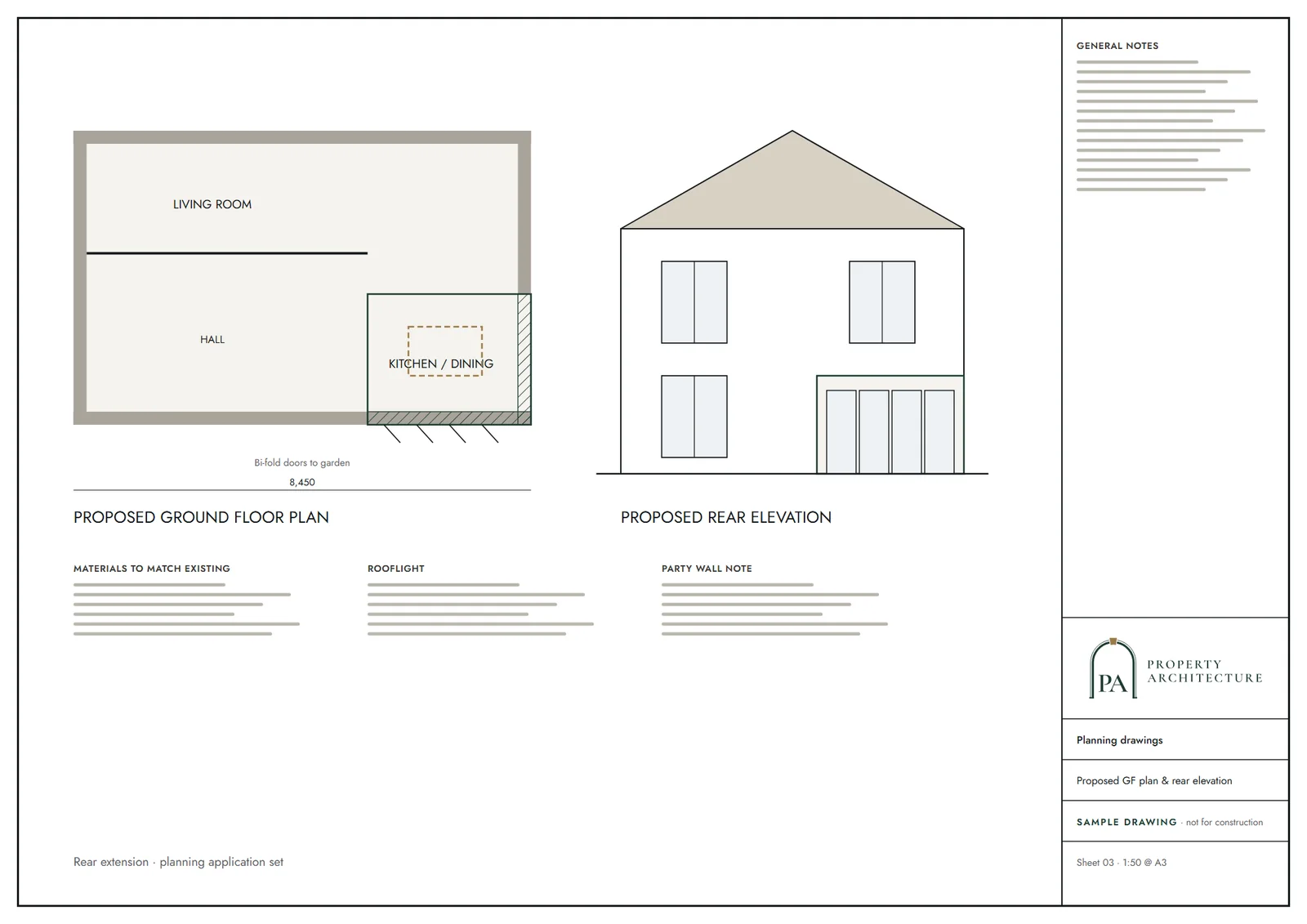
Questions
Is a Phase I desk study the same as a preliminary risk assessment?
In practice yes. Phase I desk study is a common trade name; preliminary risk assessment is the term the Environment Agency's land contamination guidance uses for the same first stage.
Does the desk study include soil sampling?
No. It is a paper and walkover study. Drilling, sampling and laboratory testing are a separate intrusive investigation, priced separately.
Will the council always accept a desk study alone?
Not always. If the report finds a credible risk, the council can ask for further investigation before it decides. The report tells you early whether that is likely.
My site is a normal house plot. Do I still need one?
Often not. The need turns on the site's history and the proposal. Tell us the address and we will say whether your council is likely to ask.
How much does a desk study cost?
It starts from £795 for a desk study and site walkover on a single plot. A larger site takes more records and more time, so we confirm that figure in writing before you book. Send the address and the proposal.
Sources and dates
- legislation.gov.uk, retrieved
- gov.uk, retrieved
- gov.uk, retrieved
- gov.uk, retrieved
- legislation.gov.uk, retrieved
- legislation.gov.uk, retrieved
- legislation.gov.uk, retrieved
- Contains public sector information licensed under the Open Government Licence v3.0.
- Contains OS data © Crown copyright and database right 2026.
- Contains HM Land Registry data © Crown copyright and database right 2026. This data is licensed under the Open Government Licence v3.0.
- Contains Historic England data © Historic England 2026. Contains Ordnance Survey data © Crown copyright and database right 2026.

Tell us about your property.
We check the constraints, then send a fixed fee. Messages before 3pm get a reply the same working day.