
Planning
Biodiversity net gain plan in London
House extensions and loft conversions are exempt from biodiversity net gain in London and across England. New homes and larger schemes can be caught, unless a site-size or de minimis exemption applies, and then they must leave habitats at least 10 per cent better than before. We prepare the plan on a fixed quote after a free constraints check, and we tell you first whether you need one at all.
Fixed quote after a free constraints check
- MCIAT chartered
- £2m PI insured
- LABC Partnered
- Fixed fees, VAT included
Request a fixed quote

Biodiversity net gain in one paragraph
Biodiversity net gain, usually shortened to BNG, is a condition that applies to planning permissions in England unless an exemption covers the scheme. The development must deliver at least a 10 per cent rise in biodiversity value compared with the site before work began, measured with the statutory metric.
It comes from the Environment Act 2021, which inserted a new schedule into the Town and Country Planning Act 1990. The gain is secured by a pre-commencement condition, so a plan has to be approved before building starts, not only before permission is granted.
The enhancement must be maintained for at least 30 years after completion. That long tail is why the plan is a real document, not a form.
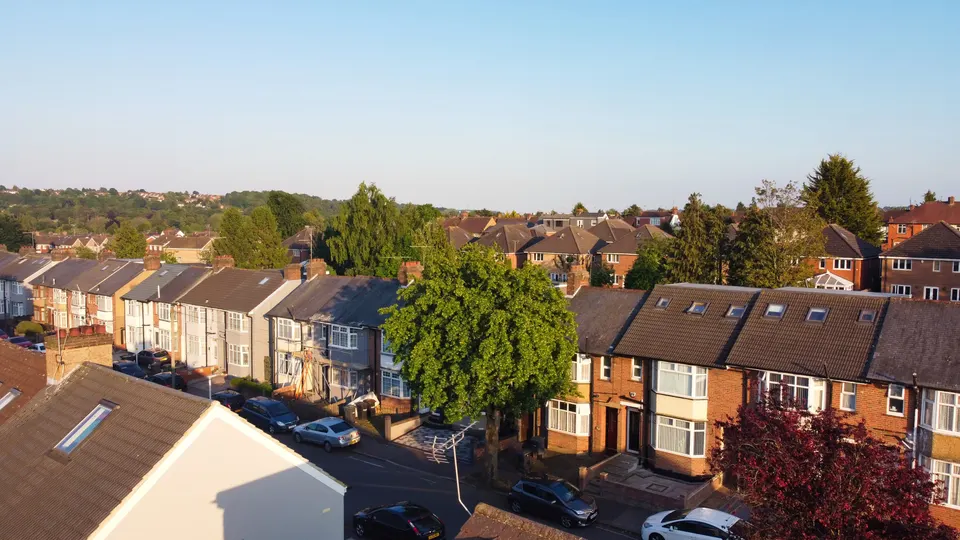
Who is exempt, and who is not
Householder applications are exempt. That means extensions, conservatories and loft conversions to an existing home do not need a plan. Permissions granted by a development order, including permitted development, are exempt too.
A further group of small impacts is excluded by the de minimis rule: where the development affects less than 25 square metres of on-site habitat, and less than 5 metres of linear habitat such as a hedgerow.
Two changes took effect this summer. Sites of 0.2 hectares or below are now exempt unless priority habitat is affected, and the self-build and custom-build exemption has gone for new applications. So a single new house on a small plot can now fall outside the rules, provided no priority habitat is touched.
When the rules reach a London householder
Schemes that are not householder applications need a closer look: a new dwelling in a rear garden, a flat conversion with a landscaping change, or a garage that becomes a separate home. For each one we test the site area, the habitat affected and any priority habitat before saying whether a plan is needed.
Even where the exemption applies, the application form must still say whether the biodiversity gain condition applies and why not. We complete that statement on every submission so the application is not made invalid by an empty box.
If a site is on or near a protected area, a mature tree group or an overgrown plot, we flag it in the free check. Do not clear the plot before you speak to us, and keep dated photographs of how it looks today.
What a BNG plan contains
The core is the completed metric calculation of the site's value before development, followed by the value after, using the habitat types, area, condition and strategic significance of each parcel. Alongside it sit a baseline survey, a map of habitat parcels and a short statement of the gain proposed.
For smaller sites there is an optional small sites metric. It is open to residential schemes of one to nine dwellings on a site of up to one hectare, but not where priority habitat, protected sites or protected species are present.
The plan then fixes how the gain is delivered and maintained. We draw the proposed planting, green roofs, hedgerows and ponds on the landscape layout so officers can match each unit in the calculation to a feature on the sheet. Our new build drawings include that layout.
On site, off site or credits
The gain can be achieved in three ways: on the development site, through registered off-site gains on the national Biodiversity Gain Site register, or, as a last resort, by buying statutory biodiversity credits.
Since this summer, for non-major development, on-site enhancement, on-site creation and registered off-site gains sit at the same level of preference. That gives a small plot more freedom to choose the route that suits the site.
We explain the options and the likely cost in plain terms before you commit, and we do not recommend off-site units where an on-site design would work as well.
How councils treat it and what it means for timing
National policy says plans should set local BNG standards above the statutory requirement only for specific site allocations, so for most London homes the figure is the national one.
Because the condition bites before work begins, the plan needs to be ready once permission arrives. We prepare it in step with the planning drawings so there is no gap between permission and starting on site. If that timing matters, speak to us about our planning consultant service, which sequences the application and its conditions.
Our independent check applies here as well: a second chartered technologist, never the person who prepared the metric, checks the calculation and the landscape sheet before they are submitted.
Price and next step
A BNG plan has no list price. The work depends on the number of habitat parcels and whether off-site units are needed, so you receive a fixed quote after a free constraints check.
Send us the address and what you want to build. We will say whether the condition applies, what the plan needs, and what it is likely to involve. For the rest of the application, see our planning drawings service.
The national rules in figures
| Measure | Value | Period | Source |
|---|---|---|---|
| Environment Act 2021 Sch 14 para 2, inserting Sch 7A TCPA 1990: 'relevant percentage' 10% | 10 % | — | legislation.gov.uk |
| Sch 7A para 9(3) as inserted: enhancement maintained for at least 30 years after completion | 30 years | — | legislation.gov.uk |
| 'Developments of 0.2 hectares or below': from 6 August 2026 BNG does not apply where the site area within the red line boundary is 0.2 ha or below | 0.2 ha | — | gov.uk |
| 'Developments subject to the de minimis rule': impact on less than 25 m2 (5 m by 5 m) of on-site habitat | 25 m2 | — | gov.uk |
| De minimis rule: impact on less than 5 m of on-site linear habitat such as hedgerows | 5 m | — | gov.uk |
| 'Temporary developments' (from 6 August 2026): whole development temporary and permission granted for 5 years or less | 5 years | — | gov.uk |
| Change history 2024-04-02: small developments subject to BNG from 2 April 2024; small-development applications made before then are exempt | 2024-04-02 | — | gov.uk |
| Section 'Householder applications' | Householder applications (defined in DMPO 2015 art 2(1)) are exempt: extensions, conservatories, loft conversions | — | gov.uk |
| Section 'Self-build and custom build applications'; change history 2026-08-06 | Removed for new applications made on or after 6 August 2026. Still applies to applications made before that date and to later variations where the original permission was exempt | — | gov.uk |
| Section on the small sites metric | Optional. Residential: 1 to 9 dwellings on a site of 1 ha or less (if dwelling number unknown, site under 0.5 ha). Commercial: floorspace under 1,000 m2 or site under 1 ha. Not minerals or waste. Not usable where priority habitat, protected sites or European protected species are present | — | gov.uk |
A blank value means the figure has not been published, not that there are none. Check your own address with the council.
Which application your project needs
The usual route for a house; flats and listed buildings follow other rules.
- A · Lawful Development Certificate decision
- 8 weeks
- B · Prior approval decision
- 42 days
- C · Householder decision
- 8 weeks
What you receive
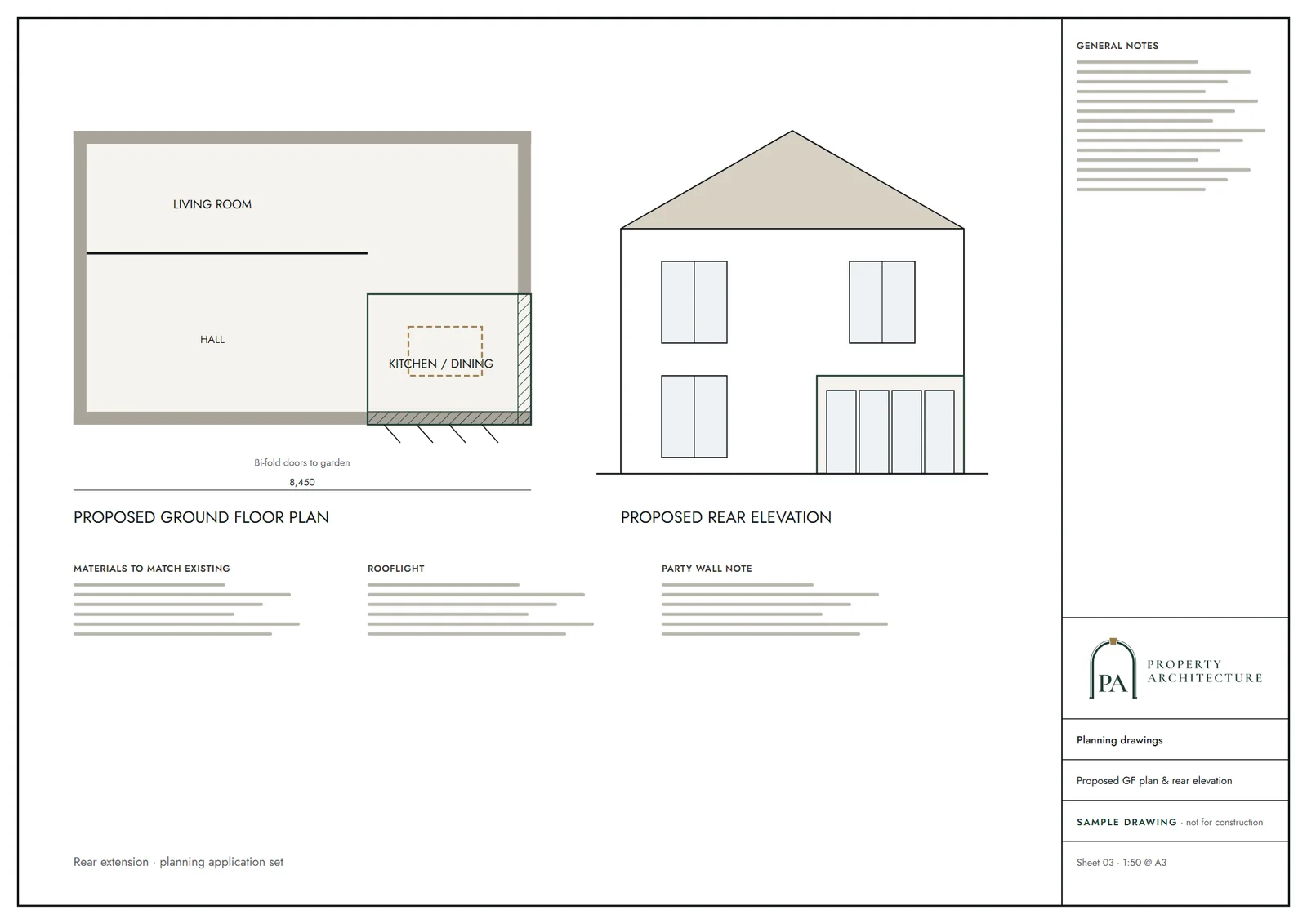

Questions
Does a house extension need a biodiversity net gain plan?
No. Householder applications, which cover extensions, conservatories and loft conversions, are exempt, and so is development permitted by a development order. The application form must still state that the condition does not apply.
What is the net gain percentage?
At least 10 per cent more biodiversity value than before development, measured with the statutory metric and maintained for at least 30 years.
Is there a minimum site size?
Sites of 0.2 hectares or below are exempt unless priority habitat is affected. Smaller impacts below 25 square metres of habitat are also excluded.
Can I buy credits instead of changing my garden?
Yes, but only after on-site and registered off-site options. Statutory biodiversity credits are the last resort in the hierarchy.
How much does a BNG plan cost?
We give a fixed quote after a free constraints check, depending on the habitats on the site and whether off-site units are needed.
Sources and dates
- legislation.gov.uk, retrieved
- gov.uk, retrieved
- gov.uk, retrieved
- legislation.gov.uk, retrieved
- legislation.gov.uk, retrieved
- legislation.gov.uk, retrieved
- Contains public sector information licensed under the Open Government Licence v3.0.
- Contains OS data © Crown copyright and database right 2026.
- Contains HM Land Registry data © Crown copyright and database right 2026. This data is licensed under the Open Government Licence v3.0.
- Contains Historic England data © Historic England 2026. Contains Ordnance Survey data © Crown copyright and database right 2026.

Tell us about your property.
We check the constraints, then send a fixed fee. Messages before 3pm get a reply the same working day.