Key takeaways
- Our fixed fee for a tree survey is £445, with no VAT to add.
- A Tree Preservation Order protects trees from several acts: cutting down, topping, lopping, uprooting, wilful damage and wilful destruction without written consentGOV.UK planning practice guidance, Tree Preservation Orders and trees in conservation areas.
- Roots count too: in the Secretary of State's view, cutting roots is also prohibited and requires consentGOV.UK planning practice guidance, Tree Preservation Orders and trees in conservation areas.
- Trees in a conservation area need notice: 6 weeks' notice to the council before certain work, unless an exception appliesGOV.UK planning practice guidance, Tree Preservation Orders and trees in conservation areas.
- Breaking the rules is an offence: to cut down, uproot or wilfully destroy a tree in contravention of an order is an offence punishable by a fineTown and Country Planning Act 1990, section 210.
What the survey costs, and what it produces
Our fee is £445. An accredited partner visits the site, identifies and measures each relevant tree, and rates it by condition and value. The result is a tree survey and a plan that shows where roots and crowns extend, which is what a designer needs before a foundation or an extension is placed. Our tree survey page lists what you receive.
The survey follows the British Standard for trees in relation to construction, BS 5837. That is the standard councils expect for an arboricultural submission, and it is why the fee is higher than a drawing alone.
Why trees can stop a scheme
A tree can be protected by an order made by the council. The order prohibits the following: cutting down, topping, lopping, uprooting, wilful damage and wilful destruction without written consentGOV.UK planning practice guidance, Tree Preservation Orders and trees in conservation areas. And it goes below ground: in the Secretary of State's view, cutting roots is also prohibited and requires consentGOV.UK planning practice guidance, Tree Preservation Orders and trees in conservation areas. A trench for foundations beside a protected tree is, in practice, a request for consent.
Trees in a conservation area that have no order are covered too. 6 weeks' notice to the council before certain work, unless an exception appliesGOV.UK planning practice guidance, Tree Preservation Orders and trees in conservation areas. The council can then decide to protect the tree. After the notice, the position is: work done after the six weeks, but within two years of the notice, is not an offence under section 211Town and Country Planning Act 1990, section 211. Our constraints check shows both situations.
What happens if a tree is cut without consent
Cutting a protected tree is an offence under the Town and Country Planning Act. In law: to cut down, uproot or wilfully destroy a tree in contravention of an order is an offence punishable by a fineTown and Country Planning Act 1990, section 210. The penalty is a fine decided by the court, which must have regard to any financial benefit gained, so the potential cost is not capped by a small sum.
The practical cost is larger. A scheme that depends on removing a tree it cannot lawfully remove cannot be built as drawn, and the redesign comes after the builder is booked. That is why the survey comes before the design.
How the survey shapes the design
The survey sets a protection area around each tree to keep. The extension or the new home is then designed around it, with foundations that sit outside the root zone or are designed to avoid damage. In a tight London garden, a tree on a neighbour's side can still limit a boundary extension.
We carry the survey into our planning drawings, so the plan and the survey show the same trees. The council can then see the design respects them.
When to order one
Order it when a tree stands within or next to the area you want to build on, when your constraints check shows a tree order or a conservation area, or when the council asks. Order it before the design is finished, not after, because the design may need to change.
If the council asks for more detail, we revise the submission with our partner.
The figures, with sources
- What a Tree Preservation Order prohibits
- cutting down, topping, lopping, uprooting, wilful damage and wilful destruction without written consentGOV.UK planning practice guidance, Tree Preservation Orders and trees in conservation areasChecked 25 October 2026
- Cutting roots
- in the Secretary of State's view, cutting roots is also prohibited and requires consentGOV.UK planning practice guidance, Tree Preservation Orders and trees in conservation areasChecked 25 October 2026
- Notice for work to trees in a conservation area
- 6 weeks' notice to the council before certain work, unless an exception appliesGOV.UK planning practice guidance, Tree Preservation Orders and trees in conservation areasChecked 25 October 2026
- Cutting down a protected tree
- to cut down, uproot or wilfully destroy a tree in contravention of an order is an offence punishable by a fineTown and Country Planning Act 1990, section 210Checked 25 October 2026
- Section 211 offence period
- work done after the six weeks, but within two years of the notice, is not an offence under section 211Town and Country Planning Act 1990, section 211Checked 25 October 2026
Questions
Do I need a tree survey for every project?
No. It is needed when trees on or beside the site are affected by the work. We tell you after the constraints check whether yours is one of those.
Can I remove a tree in a conservation area?
Not without giving the council notice first, unless an exception applies. The council can respond by making a Tree Preservation Order. Ask us before you cut.
What does BS 5837 mean?
It is the British Standard for trees in relation to design, demolition and construction. A survey to that standard is what councils expect with a planning application where trees matter.
Who does the survey?
An accredited partner, coordinated by us, so the results fit your drawings.
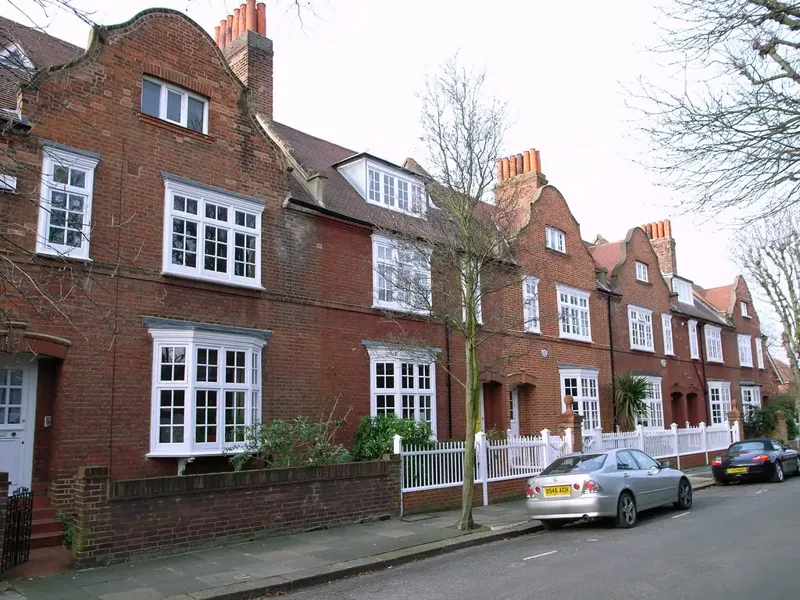
Header photo: A row of colour-washed Victorian terrace houses on Falkland Road in Kentish Town under a blue sky by Images George Rex, CC BY-SA 2.0.