Key takeaways
- Our fixed fee is £429 drawings + £200 survey (£629 total), with the measured survey included.
- The council's fee for a proposed project is half the normal planning feeRibble Valley Borough Council, guide to the national fee scale from 1 April 2026, which for a householder application is half of £548Ribble Valley Borough Council, guide to the national fee scale from 1 April 2026.
- The certificate is strong proof: lawfulness is conclusively presumed unless there is a material change before the work beginsTown and Country Planning Act 1990, section 192(4).
- A decision is due within 8 weeksDevelopment Management Procedure Order 2015, article 39 of a valid application.
- It covers planning law only. Building regulations and the Party Wall etc. Act are separate.
What the certificate is, and what you are paying for
Permitted development lets you build certain things without a planning application, but it does not tell you anyone has agreed that your design fits. A lawful development certificate does. You apply to the council with drawings, and the council issues a certificate that says the project is lawful. The law behind it is plain: lawfulness is conclusively presumed unless there is a material change before the work beginsTown and Country Planning Act 1990, section 192(4).
That is why buyers and lenders like it. Without it, a solicitor has only the owner's word that an extension was within the limits.
The two costs, side by side
Our part is £429 drawings + £200 survey (£629 total): a measured survey of the house and the drawings the council needs to judge the project. The council's part, for a proposed project, is half the normal planning feeRibble Valley Borough Council, guide to the national fee scale from 1 April 2026. For a householder application, the normal planning fee is £548Ribble Valley Borough Council, guide to the national fee scale from 1 April 2026, so the certificate costs half of that.
If the certificate is for something already built, the fee is higher: the same as a full planning applicationRibble Valley Borough Council, guide to the national fee scale from 1 April 2026. That matters if you are regularising work from a previous owner.
Will your project qualify? The tests that decide it
A certificate can only confirm what the rules already allow, so the project has to fit them. For a single-storey rear extension the limit is 4 metres beyond the rear wall of the original house if detached, or 3 metres for any other houseGeneral Permitted Development Order 2015, Schedule 2, Part 1, Class A. For a loft, no more than 40 cubic metres added to a terrace house, or 50 cubic metres to any other houseGeneral Permitted Development Order 2015, Schedule 2, Part 1, Class B. Both have more conditions about height, eaves and materials. Our rear extension drawings and loft conversion drawings pages cover those limits for each project.
Where London catches people is the location. The permitted development rights are narrower in conservation areas, and flats have none of the householder rights at all. We check the address against the rules before quoting, and if the project does not fit, we say so, because a certificate cannot be issued for something that needs permission.
When a certificate is worth paying for
You can build under permitted development without a certificate, and many owners do. The certificate is worth having when you plan to sell, when a lender or a neighbour might question the limits, or when the design sits close to one. The cost is small compared with discovering, years later, that an extension is a few centimetres over a limit.
There is also a time limit on the council's side for unlawful work: ten years from substantial completionTown and Country Planning Act 1990, section 171B. A certificate for existing work helps you show the council the work is lawful, and if it is not, our retrospective planning application is the next step.
How long it takes
Once the application is valid, the council must give a decision within 8 weeksDevelopment Management Procedure Order 2015, article 39, or a longer period if you agree one. Our drawings are normally ready about a week after the survey. If the council asks for changes, we redraw at no charge.
A certificate is about planning only, so it does not replace the other approvals. A loft still needs building regulations approval, and the neighbour's wall still needs a party wall notice. The steps below are the order we work in.
The figures, with sources
- Council fee for a certificate for a proposed use or operation
- half the normal planning feeRibble Valley Borough Council, guide to the national fee scale from 1 April 2026Checked 25 October 2026
- National planning fee, extension or alteration to a single house
- £548Ribble Valley Borough Council, guide to the national fee scale from 1 April 2026Checked 25 October 2026
- Council fee for a certificate for an existing use or operation
- the same as a full planning applicationRibble Valley Borough Council, guide to the national fee scale from 1 April 2026Checked 25 October 2026
- Legal effect of a certificate for proposed work
- lawfulness is conclusively presumed unless there is a material change before the work beginsTown and Country Planning Act 1990, section 192(4)Checked 25 October 2026
- Time for the council to decide a certificate application
- 8 weeksDevelopment Management Procedure Order 2015, article 39Checked 25 October 2026
- Permitted development limit for a single-storey rear extension
- 4 metres beyond the rear wall of the original house if detached, or 3 metres for any other houseGeneral Permitted Development Order 2015, Schedule 2, Part 1, Class AChecked 25 October 2026
- Loft extension volume limit under permitted development
- no more than 40 cubic metres added to a terrace house, or 50 cubic metres to any other houseGeneral Permitted Development Order 2015, Schedule 2, Part 1, Class BChecked 25 October 2026
- Time limit for enforcement against building works done without permission in England
- ten years from substantial completionTown and Country Planning Act 1990, section 171BChecked 25 October 2026
Questions
Is a lawful development certificate the same as planning permission?
No. Planning permission is the council's approval of a project that needs it. A certificate is the council's confirmation that a project does not need it. If the project does need permission, a certificate cannot be issued.
Do I have to get one before I build?
No, permitted development rights apply without one. A certificate is optional proof, most useful when you sell or when the design is close to a limit.
Does the certificate cover the building regulations?
No. It covers planning law only. A loft or extension still needs building regulations approval, and work on a party wall still needs a notice under the Party Wall etc. Act.
Can you get one for work that is already built?
Yes, if the work is lawful. The fee for an existing project is different, and we measure the work as it stands. If the work is not lawful, the route is a retrospective planning application.
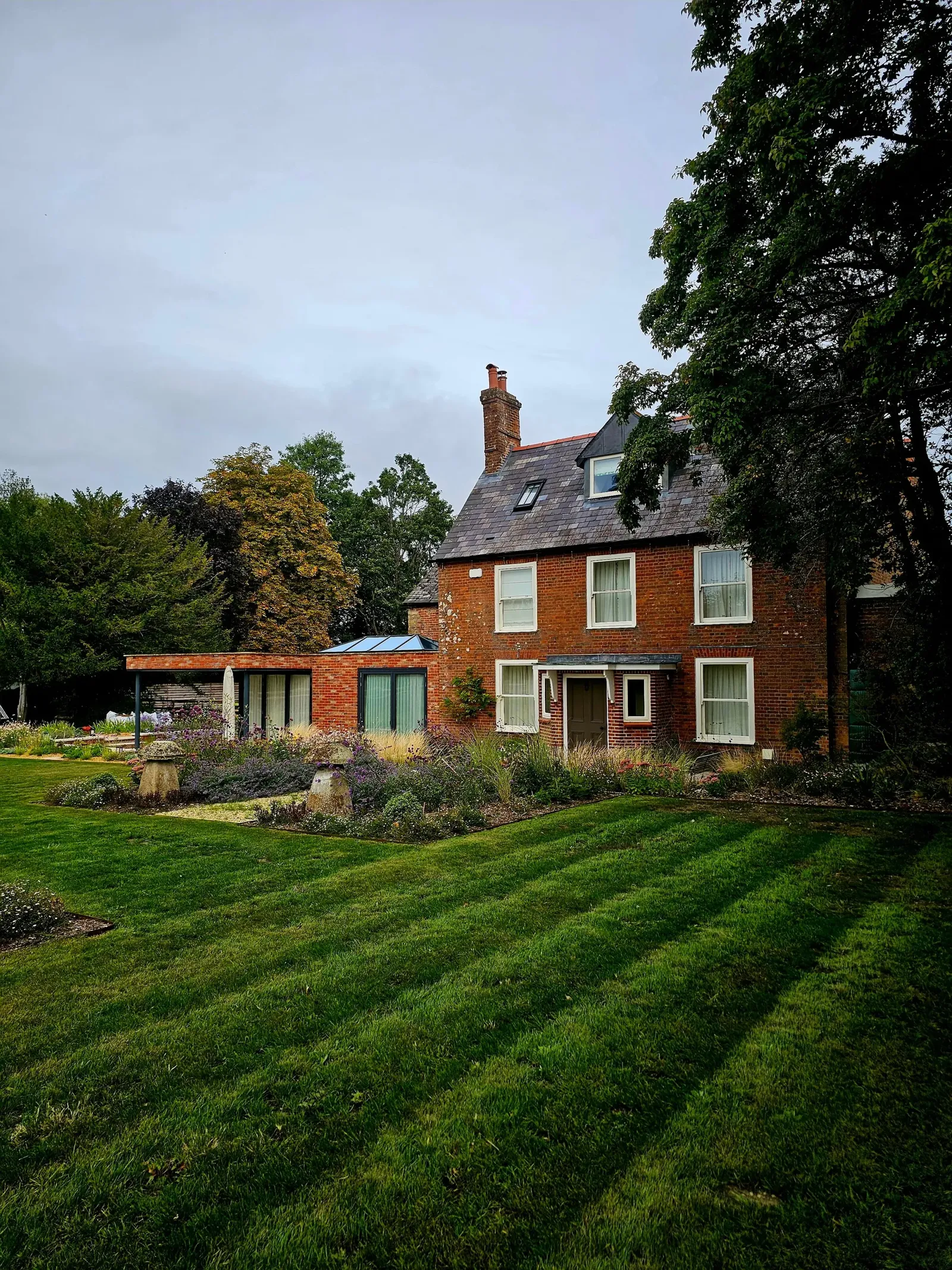
Header photo: A red-brick house with a slate roof and roof windows, a low glazed extension on its garden side and a striped lawn in front by Scott Hayward, Pexels License.