
Hillingdon, London
Biodiversity net gain plans in Hillingdon
A biodiversity net gain plan in Hillingdon is needed only when a scheme is not a householder job: a new home on a large plot, a garden split in two, or a barn-style conversion at the edge of the borough. Where it applies, the site must end up at least 10 per cent richer in habitat than it began. We prepare the plan on a fixed quote after a free constraints check, and tell you first whether yours is exempt.
Fixed quote after a free constraints check
- MCIAT chartered
- £2m PI insured
- LABC Partnered
- Fixed fees, VAT included
Request a fixed quote
How we work on biodiversity net gain plans
Seven steps from first call to approval.
Enquiry and constraints check
We check the property against conservation areas, listed status, Article 4 directions, tree preservation orders, flood zone and planning history. We choose the right route and send a fixed quote.
Measured survey
We survey the house on one datum: rooms, levels, boundaries, drains, trees and the neighbours' windows that the 45° and 25° tests depend on.
Design options
We model the house in Revit and show you options in 3D and plan, with the planning strategy and the precedents in your street.
Design frozen
You choose an option in writing. Nothing changes after this without your say.
Independent check
A second chartered technologist checks every sheet against the council's validation checklist and the policy. A senior review signs it off before anything is submitted.
Submission
We prepare the forms, certificates, fee and documents and submit through the Planning Portal.
Officer liaison
We answer the planning officer and make any amendments within five working days, at no charge until approval.
Free redraws until approval. Every drawing set is checked independently, and the checker is never the person who drew it.
Request a fixed quote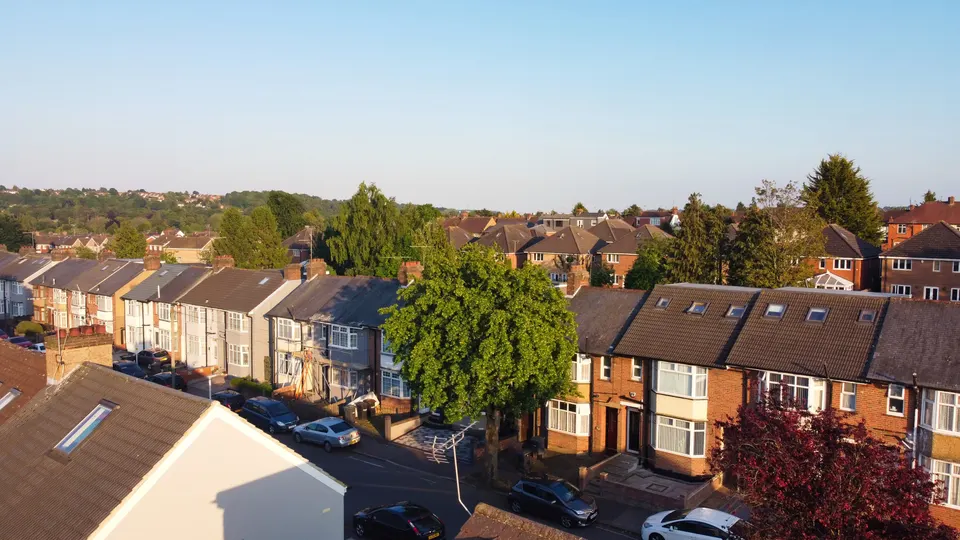
Hillingdon's land mix decides whether a plan is needed
We have not found a Hillingdon validation rule on biodiversity that goes beyond the national condition, so the national condition does the work and the question becomes what sits on your plot. Green Belt polygons cover 42 per cent of the borough, a large share of the land, and a site inside them is far more likely to hold grassland, hedgerow or mature planting that counts as habitat in the statutory metric.
Domestic gardens make up 18.6 per cent of land in the borough. A back garden is not exempt simply because it is a garden. Where a new dwelling replaces part of one, the lawn, shrubs and boundary hedging all go into the baseline calculation.
The borough also records 731 tree preservation orders. A protected tree on or beside the plot changes both the baseline value and where a building can sit, so we plot every protected stem before a layout is fixed.

Local figures for Hillingdon
| Measure | Value | Period | Source |
|---|---|---|---|
| Green Belt share of the council area | 42 % of council area covered by green-belt polygons | — | planning.data.gov.uk |
| Tree preservation orders | 731 tree preservation orders published by the council | — | planning.data.gov.uk |
| Domestic gardens share of land (GLUD 2005) | 18.6 % of land that is domestic garden (GLUD 2005) | 2005 | data.london.gov.uk |
| Householder applications granted | 90.2 % | 1 July 2025 - 30 June 2026 | assets.publishing.service.gov.uk |
| Minor applications granted | 68.7 % | 1 July 2025 - 30 June 2026 | assets.publishing.service.gov.uk |
| Minor application decisions | 367 decisions | 1 July 2025 - 30 June 2026 | assets.publishing.service.gov.uk |
| Environment Act 2021 Sch 14 para 2, inserting Sch 7A TCPA 1990: 'relevant percentage' 10% | 10 % | — | legislation.gov.uk |
| Sch 7A para 9(3) as inserted: enhancement maintained for at least 30 years after completion | 30 years | — | legislation.gov.uk |
| 'Developments of 0.2 hectares or below': from 6 August 2026 BNG does not apply where the site area within the red line boundary is 0.2 ha or below | 0.2 ha | — | gov.uk |
| 'Developments subject to the de minimis rule': impact on less than 25 m2 (5 m by 5 m) of on-site habitat | 25 m2 | — | gov.uk |
| Householder decisions | 1,147 decisions | 1 July 2025 - 30 June 2026 | assets.publishing.service.gov.uk |
A blank value means the figure has not been published, not that there are none. Check your own address with the council.
Which application your project needs
The usual route for a house; flats and listed buildings follow other rules.
- A · Lawful Development Certificate decision
- 8 weeks
- B · Prior approval decision
- 42 days
- C · Householder decision
- 8 weeks
Which Hillingdon projects fall outside the rules
An extension, porch or loft conversion on an existing house is a householder application and exempt, as is anything built under permitted development. A new house on a site no bigger than 0.2 hectares is also exempt, provided no priority habitat is affected.
Hillingdon's Green Belt location matters here. A plot of that size beside open land can still hold priority habitat, such as traditional orchard or lowland meadow, and one such parcel removes the small-site exemption. We check the habitat mapping before telling you the exemption holds.
Smaller disturbances can be ignored altogether: under 25 square metres of habitat and 5 metres of hedgerow or similar linear habitat count as de minimis.
A practical test before you spend anything: walk the plot and photograph it as it is today, with dates. If the land is mown lawn, paving and a few shrubs, the baseline is low and the gain is easy to meet. If it is rough grass, scrub or old fruit trees, expect a bigger task, and do not clear it first, because clearing can be treated as lowering the baseline.
What we draw and calculate for a Hillingdon site
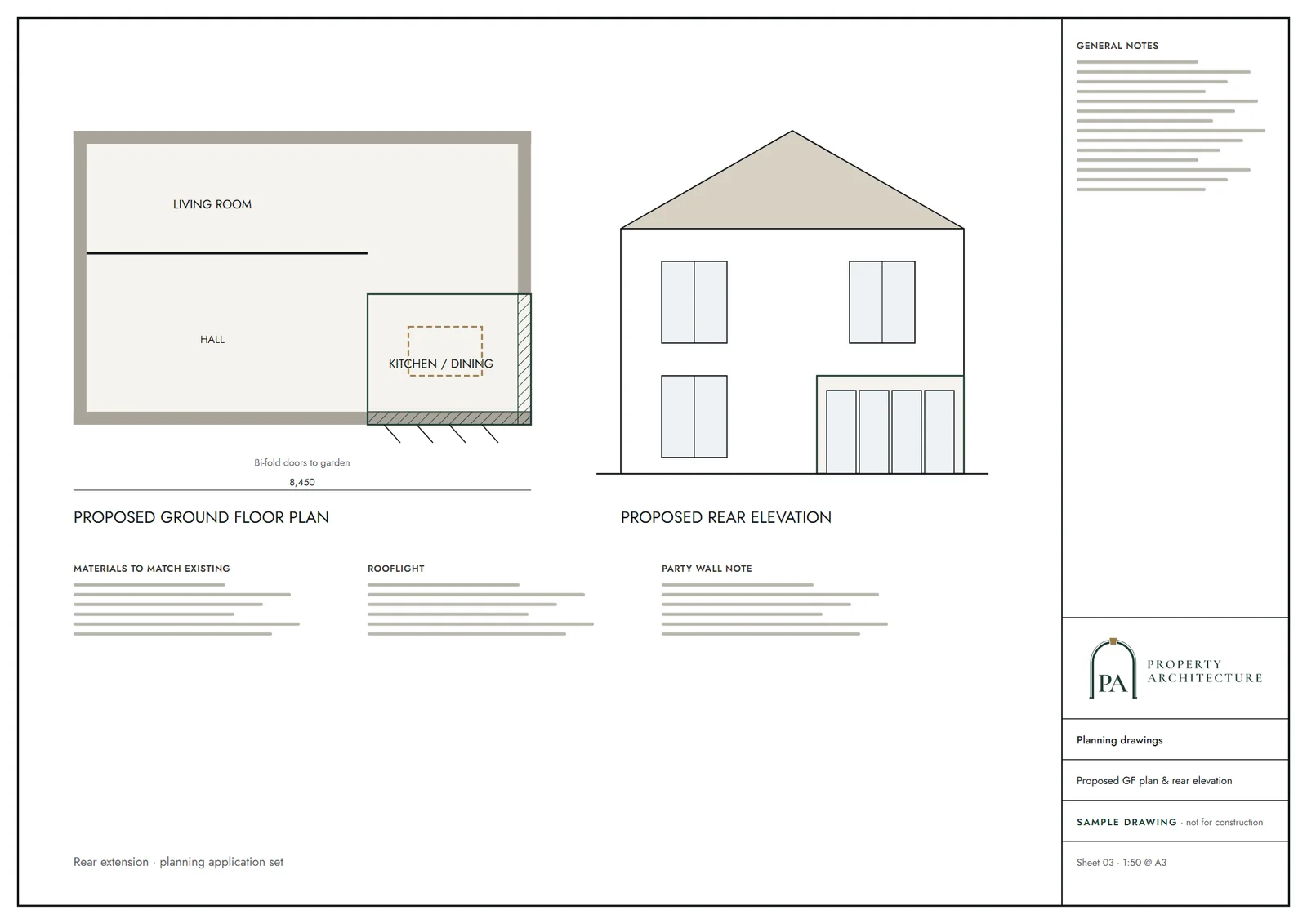
The plan starts with a baseline survey, each habitat parcel mapped with its area and condition. We then calculate the post-development value and draw the planting, green roofs, hedges and ponds that deliver the gain, so an officer can tie each unit of the metric to a feature on the sheet.
Plots near the Green Belt edge often suit on-site delivery, because there is room to keep a wildlife strip along the boundary instead of paying for off-site units. Our new build drawings carry the same landscape layout, so the plan and the planning set agree.
Whatever is delivered must be kept up. The gain is secured for at least 30 years, so we also write the management notes that explain who looks after each parcel.
Timing against the planning decision
Householder cases in Hillingdon are granted 90.2 per cent of the time, but minor applications, the category a new dwelling usually falls in, are granted 68.7 per cent of the time across 367 decisions. The gap shows why a new-home scheme needs its ecology tidy at submission.
The net gain condition is discharged before work starts, not at validation. We prepare the plan alongside the drawings so you are not waiting on a metric when the permission arrives. If a refusal is possible, see how our planning appeals work is run.
Householder decisions in the borough also run to 1,147 cases, so officers know the exemption well. They look harder at a scheme that claims it for something that is really a new dwelling, which is another reason we state the basis for any exemption on the form.
Price and how to start
There is no list price for this plan, because the work follows the number of habitat parcels and whether off-site units are needed. You get a fixed quote after a free constraints check.
Send the address and a sketch of what you plan to build. We will say if the condition applies, what survey it needs and what to avoid doing to the plot first. Wider drawings for the same site are covered under our planning drawings service.
What you receive
Related pages
Other services in Hillingdon
Biodiversity net gain plans nearby
Questions
Is a Hillingdon garden extension exempt from biodiversity net gain?
Yes, if it is a householder application. The application form still has to state that the condition does not apply.
Does Green Belt land change the gain required?
No, the figure stays at 10 per cent, but Green Belt sites often hold more habitat, so the baseline and the survey matter more.
Can protected trees affect the plan?
Yes. Hillingdon has 731 tree preservation orders, and a protected tree changes the baseline and the buildable area.
How long must the gain be maintained?
For at least 30 years after the development is finished.
Sources and dates
- planning.data.gov.uk, retrieved
- planning.data.gov.uk, retrieved
- data.london.gov.uk, retrieved
- assets.publishing.service.gov.uk, retrieved
- legislation.gov.uk, retrieved
- gov.uk, retrieved
- legislation.gov.uk, retrieved
- legislation.gov.uk, retrieved
- legislation.gov.uk, retrieved
- Contains public sector information licensed under the Open Government Licence v3.0.
- Contains OS data © Crown copyright and database right 2026.
- Contains HM Land Registry data © Crown copyright and database right 2026. This data is licensed under the Open Government Licence v3.0.
- Contains Historic England data © Historic England 2026. Contains Ordnance Survey data © Crown copyright and database right 2026.

Tell us about your property.
We check the constraints, then send a fixed fee. Messages before 3pm get a reply the same working day.